Kosovo is a young and dynamic country, with almost 50% of the population under 30 and around 18% aged between 15 and 24. In this feature, we look at the higher education system, what university networks are in place, how much it costs to study and what the extraordinary National Library in Pristina is famous for. If you’re looking for business partners, internships or education programmes in the Balkans – Kosovo may surprise you.
A new country with a new population structure
The Republic of Kosovo is one of the youngest countries in Europe. Independence was declared in 2008. The country has a total population of around 1.8 million. This demographic profile makes education, science and human capital development priorities of national policy.
The National Library of Kosovo: between Brutalism and Symbolism
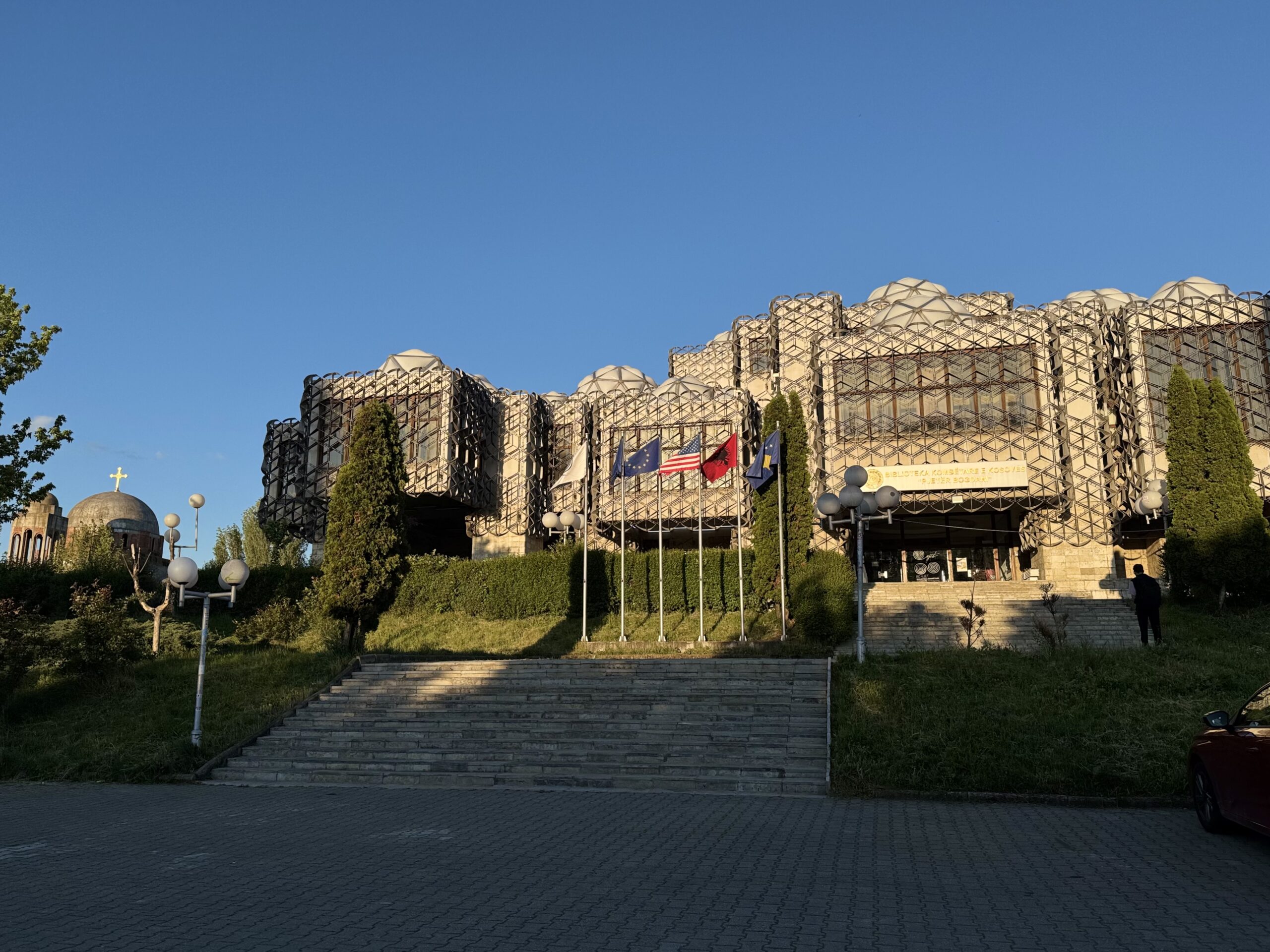
One of the most talked-about architectural symbols in Pristina, the capital of Kosovo, is the National and University Library of Kosovo (“National Library of Kosovo ‘Pjetër Bogdani'”). The building was inaugurated in 1982 and immediately sparked controversy: its style – a combination of modernism and brutalism with 99 domes and a metal grid – leaves no one indifferent.
But behind this unusual architecture lies an intellectual mission: the library serves as a national archive, as well as a place for research and academic work. It serves not only the students of the University of Pristina, but also all scholars, researchers and teachers in the country. Tens of thousands of books, manuscripts and scholarly publications are held here, including literature in Albanian, Serbian, Turkish, English and other languages.
Universities in Kosovo: structure and features
Main higher education institutions:
University of Prishtina (“University of Prishtina ‘Hasan Prishtina'”)
– The largest and oldest public university, founded in 1970
– More than 40 000 students
– Teaching is mainly in Albanian
RIT Kosovo (American University in Kosovo)
– Rochester Institute of Technology (USA)
– Teaching is in English
– Internationally recognised diploma, accredited in the USA
AAB College, UBT College, Iliria College
– Private universities with programmes in law, economics, IT, health and social sciences
Admission conditions:
– National universities require a final exam (Matura Shtetërore) to be admitted to the competition.
– At private universities, a certificate and an interview are enough, but tuition fees are always charged
– Exchange programmes with the EU (Erasmus+) and the US allow students to study abroad
Tuition fees:
– State universities: between €200 and €400 per year (depending on programme and faculty)
– Private universities: €1000 to €3000 per year
– RIT Kosovo: up to €6,000 per year (scholarships available)
Students:
– Most students are Kosovo citizens
– There are students from Albania, North Macedonia, Montenegro, as well as from the diaspora
– English language programmes are available for international students at international universities
Kosovo as a scientific partner: potential and challenges
Although its scientific infrastructure is still developing, Kosovo is actively integrating into the international education and research landscape. Many universities are participating in Erasmus+, Horizon Europe and IPA projects, seeking to attract partners for joint research, especially in the fields of digital technologies, sustainable development and law.
If you are looking for young professionals, academic partners or research destinations in the Western Balkans – Kosovo is definitely on your shortlist. There is no shortage of young talent here, open to learning, innovation and international cooperation.